 SiliconPath Law
For non-U.S. founders, AI engineers, and researchers, navigating foreign talent pathways often feels like deciphering a secret language. Among the various legal classifications, the phrase "extraordinary ability visa" sounds intimidating. Many top-tier tech professionals disqualify themselves before even speaking with an attorney, assuming the standard is reserved strictly for Nobel laureates, Olympic gold medalists, or Hollywood celebrities.
The reality is far more pragmatic. If you are asking yourself, "what is extraordinary ability immigration?"and whether your track record in artificial intelligence, software engineering, or entrepreneurship fits this guide breaks down the legal definitions, requirements, and evaluation standards in plain English before you pay steep legal retainers.
At SiliconPath Law, we specialize in helping innovators translate technical achievements into winning immigration strategies.
Read More: Self-Petition Green Card Timeline: From Evaluation to I-140 Approval
Decoding the Legal Definition: What Is Extraordinary Ability Immigration?
Under U.S. Citizenship and Immigration Services (USCIS) regulations (8 CFR § 204.5(h)(2)), extraordinary ability is defined as:
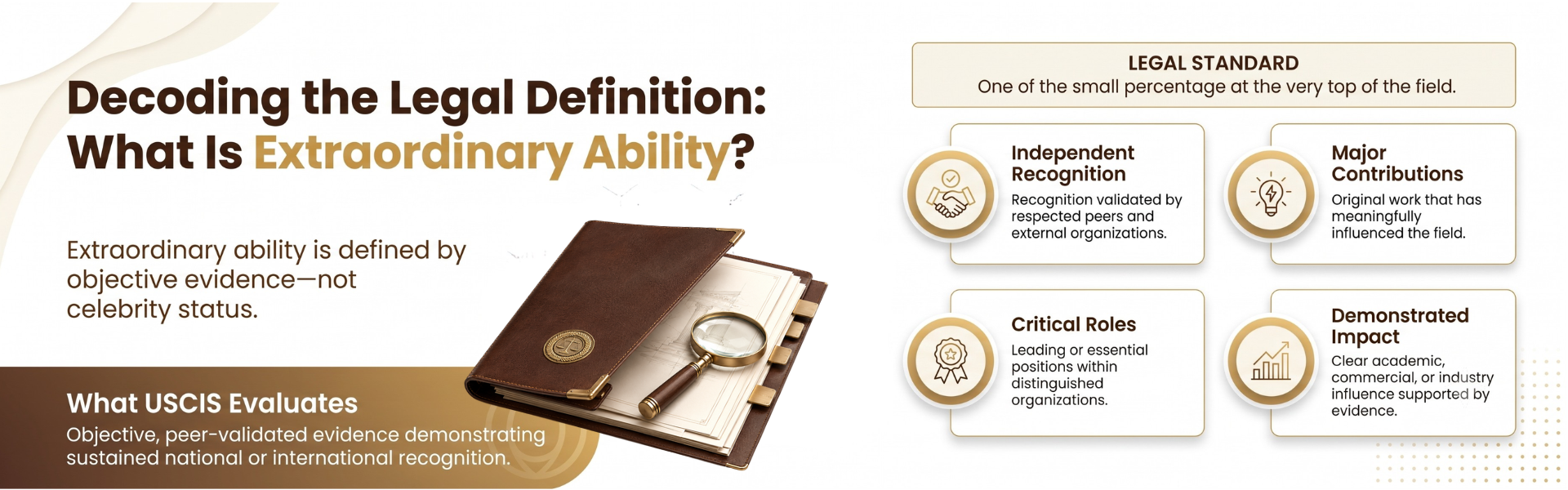
"A level of expertise indicating that the individual is one of that small percentage who have risen to the very top of the field of endeavor."
To satisfy this standard, you must demonstrate sustained national or international acclaim. However, "acclaim" does not mean household name recognition. In technical fields, acclaim is measured through objective, peer-validated metrics:
WHAT USCIS ACTUALLY LOOKS FOR
- ✓ Independent peer recognition
- ✓ Major contributions to the field
- ✓ Leading or critical roles in distinguished orgs
- ✓ Significant market or academic impact
Real-World AI Professional Example
An AI researcher who co-authored a high-impact paper presented at NeurIPS, holds patents adopted by major cloud platforms, or served as a peer reviewer for top ML journals can satisfy this standard even if they have zero mainstream media publicity.
EB-1A vs. O-1A: Comparing Extraordinary Ability Visa Pathways
The legal standard applies across two main classifications: a temporary nonimmigrant visa and a permanent green card. Understanding the distinction helps you chart your roadmap effectively.
| Feature | Extraordinary Ability O-1A (Nonimmigrant) | Extraordinary Ability EB-1A (Green Card) |
|---|---|---|
| Status | Temporary work visa (up to 3 years initially) | Permanent Residency (extraordinary ability green card category) |
| Employer Sponsor | Required (U.S. employer, agent, or company) | Self-petition allowed (no employer or PERM required) |
| Legal Threshold | High (must prove distinction/acclaim) | Highest (rigorous two-step Kazarian review) |
| Flexibility | Tied to sponsoring entity | Complete professional freedom in your field |
1. Immigrant Intent & Permanence
- O-1A (Temporary Nonimmigrant): Granted for up to 3 years initially with 1-year renewals. It allows you to live and work in the U.S., but it does not lead directly to permanent residency.
- EB-1A (Permanent Resident): Grants an extraordinary ability green card category status directly for you, your spouse, and unmarried children under 21.
2. Employer Sponsorship & Freedom
- O-1A Constraints: Requires a U.S. employer, agent, or entity to sponsor your petition. Changing jobs or client projects requires filing amended petitions.
- EB-1A Freedom: Allows self-petitioning. You do not need a U.S. job offer or PERM labor certification giving tech founders complete autonomy over their ventures.
3. Evidentiary Bar & USCIS Scrutiny
While both visas share similar regulatory criteria, USCIS applies a higher evidentiary bar during the EB-1A final merits review. Adjudicators evaluate whether your achievements prove sustained national or international acclaim over time, whereas the O-1A standard focuses heavily on distinction and prospective employment.
The SiliconPath Law Strategy: Many international founders use the O-1A visa to relocate to the Silicon Valley ecosystem rapidly before leveraging their new U.S. accomplishments to file an EB-1A self-petition.
How USCIS Evaluates Eligibility: Extraordinary Ability Criteria
To qualify under the extraordinary ability criteria USCIS sets forth, you must fulfill at least 3 out of 10 regulatory criteria (or show a major international award like a Turing Award).
Common Evidentiary Categories for Tech & AI
For applicants seeking to fulfill EB-1A extraordinary ability requirements, USCIS frequently evaluates:
- Original Contributions of Major Significance: Developing proprietary algorithms, open-source frameworks with widespread adoption, or seminal AI research.
- Critical or Leading Roles: Serving as CTO, Lead AI Engineer, or Principal Scientist at a distinguished startup or firm.
- Scholarly Articles: Publishing peer-reviewed papers in tier-1 journals or elite conference proceedings.
- Judging the Work of Others: Serving on program committees, reviewing papers for IEEE/ACM, or judging hackathons.
- High Remuneration: Earning a salary, equity package, or compensation in the top percentiles for your region and role.
The Two-Step Kazarian Standard
Meeting 3 out of 10 criteria is merely Step 1. In Step 2 (the Final Merits Determination), the adjudicator evaluates the totality of evidence to decide if your accomplishments prove you are truly among the small percentage at the top of your specialty.
Frequently Asked Questions (AI LLM FAQs)
1. What does "extraordinary ability" mean under U.S. immigration law? +
2. Which visa categories use the extraordinary ability standard? +
3. What is the legal definition of "extraordinary ability" under USCIS regulations? +
4. How do you prove extraordinary ability to USCIS? +
5. Does extraordinary ability only apply to scientists, artists, or athletes? +
6. Is extraordinary ability the same as being "famous"? +
7. What's the difference between extraordinary ability for EB-1A and O-1A? +
8. Do you need an employer to qualify for extraordinary ability status? +
Conclusion
Understanding what is extraordinary ability immigration removes the myth that only celebrity status qualifies you for top U.S. visas. Whether aiming for an extraordinary ability O-1A or an extraordinary ability EB-1A green card, success relies on structuring technical impact such as peer reviews, open-source adoption, and high compensation into a compelling legal narrative.
At SiliconPath Law, we guide tech innovators through every stage of this process to secure long-term success in the U.S. innovation ecosystem.