
 SiliconPath Law
Does Meeting EB-1A's Three Criteria Guarantee Approval?
Securing an EB-1A petition approval requires navigating a complex legal landscape. Many applicants believe that checking three out of the ten regulatory boxes on the United States Citizenship and Immigration Services (USCIS) checklist guarantees an approval notice. However, the truth is that it does not.
In practice, USCIS routinely employs a highly subjective second step known as the EB-1A Final Merits Determination (FMD). This stage often operates as a legal "black box," allowing adjudicators to deny objectively qualified petitions even after acknowledging that the technical baseline has been met.
At SiliconPath Law, our advice to clients is direct: you cannot simply build a case that satisfies the basic regulatory requirements; your petition must be strategically engineered to survive the FMD.
The Illusion of the 3-of-10 Checklist
"I provided rock-solid proof for four different criteria. Why did I receive a denial?"
This is one of the most frequent and frustrating questions potential clients ask during initial consultations.
It highlights a widespread misconception within the professional community: the idea that the EB-1A extraordinary ability visa is a simple compliance checklist.
Many highly accomplished professionals, particularly in fields like artificial intelligence, software engineering, and advanced research, approach the immigration process as a technical optimization problem.
They gather documentation for their publications, high salaries, and critical roles, assuming that meeting the numerical threshold equals success. Unfortunately, this reliance on a simple checklist overlooks the reality of how the agency evaluates these cases.
The adjudication process is divided into two distinct parts. This structure sets up an inherent conflict between objective rule-following by the applicant and subjective gatekeeping by the government, turning what should be a transparent process into a complex legal hurdle.
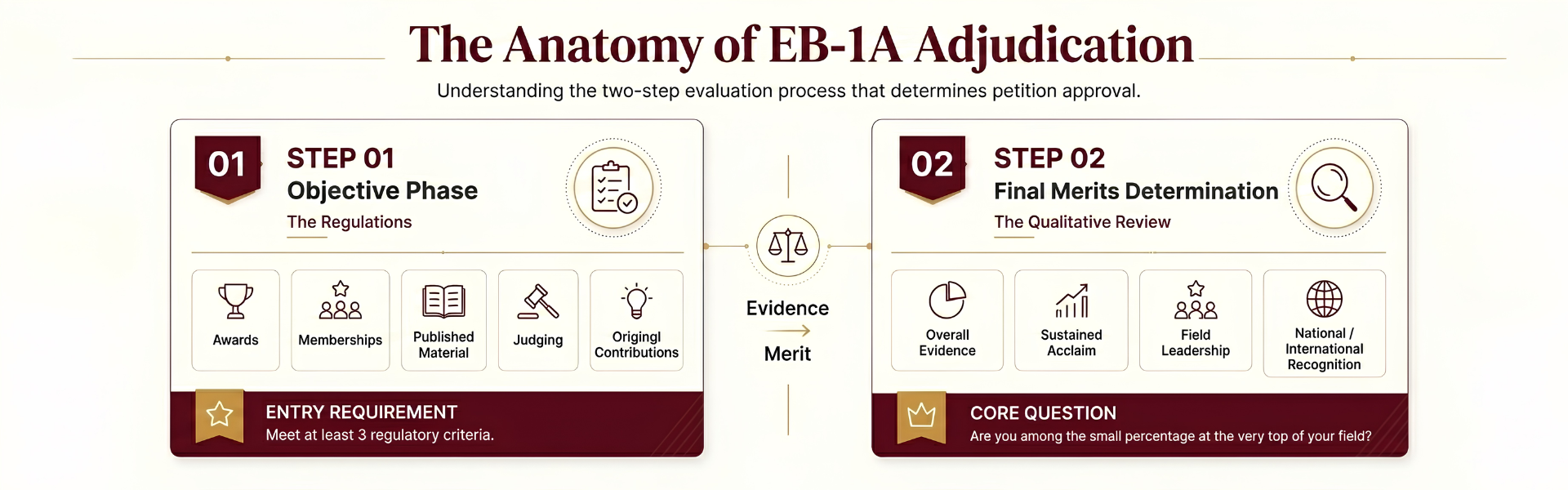
The Anatomy of EB-1A Adjudication: Step One vs. Step Two
In order to successfully navigate this process, you must understand the two distinct phases of the Kazarian two-step analysis, which governs how the agency reviews your evidence.
Step 1: The Objective Phase (The Regulations)
The initial phase focuses strictly on the text of the regulations. It outlines ten specific EB-1A criteria, including achievements such as:
- Documented receipt of lesser nationally or internationally recognized prizes or awards.
- Membership in associations that require outstanding achievements of their members.
- Published material about the applicant in professional or major trade publications.
- Evidence of the applicant's participation as a judge of the work of others.
- Evidence of original scientific, scholarly, artistic, athletic, or business-related contributions of major significance.
Satisfying at least three of these benchmarks is the baseline requirement. You can think of Step One as the entry ticket that gets your petition through the door for serious consideration.
Step 2: The Subjective Phase (The Final Merits Determination)
Once an officer concludes that you have checked at least three regulatory boxes, they move to the final merits determination (FMD) phase.
At this stage, the adjudicator evaluates the totality of the EB-1A extraordinary ability evidence to make a qualitative judgment.
The core question shifts from "did they meet three criteria?" to "is this individual truly part of the small percentage who have risen to the very top of the field of endeavor?"
The Legal Friction
This two-step process creates significant legal friction. In practice, USCIS officers frequently use Step Two to move the goalposts, re-litigating and discounting evidence that they already approved during the first step.
| Adjudication Stage | What the Law Requires | What USCIS Frequently Does |
|---|---|---|
| Step 1: Regulatory Criteria | Provide objective evidence satisfying at least 3 of 10 criteria. | Evaluates the evidence mechanically to see if the baseline is met. |
| Step 2: Final Merits (FMD) | Conduct a holistic review of the applicant's overall sustained national or international acclaim. | The Trap: Re-evaluates Step 1 evidence under stricter, unwritten standards to issue a denial. |
The Origin Story: How the Kazarian Framework Was Twisted
To understand why the EB-1A Final Merits Determination became such a formidable barrier, we need to examine its historical origins.
The framework stems from the landmark case Kazarian v. USCIS (9th Cir. 2010). Originally, the Ninth Circuit Court of Appeals intended this two-step analysis to protect applicants.
The court observed that adjudicators were improperly inventing extra rules during the initial criteria phase, such as demanding a specific number of citations before counting a scholarly article. The court ruled that officers must first determine if the evidence fits the literal definition of the criteria, reserving the holistic evaluation for a second, separate step.
However, the agency quickly hijacked the Kazarian ruling. Rather than using it to ensure fair processing, USCIS codified the two-step framework into its official policy memos in a way that transformed the final merits stage into an elastic, subjective shield.
For over a decade, this interpretation allowed officers to bypass the objective limitations of Step One. It gave them the latitude to issue denials based on vague conclusions that an applicant lacked sufficient prestige, effectively neutralizing strong, evidence-backed petitions.
The 2026 Legal Rebellion: Mukherji v. Miller
For years, applicants had little recourse against these subjective denials. However, the legal landscape shifted dramatically with the federal court decision in Mukherji v. Miller (D. Neb. 2026).
The Case
The plaintiff, a highly accomplished journalist specializing in global geopolitical reporting, submitted a comprehensive petition that satisfied five distinct regulatory criteria. Despite this extensive documentation, USCIS issued a denial during the final merits stage.
The agency argued that her achievements lacked "recency," asserting that because her most prominent international awards were won a few years prior, she failed to demonstrate current extraordinary ability.
The Judicial Takedown
The U.S. District Court reviewed the agency's actions and issued a decisive ruling that challenged the foundation of the FMD framework, focusing on two massive findings:
- Administrative Procedure Act (APA) Violation: The court ruled that the FMD, as applied by USCIS, constituted a substantive rule change rather than a mere interpretation of existing regulations. As the agency implemented this framework through policy memos without the legally required public notice-and-comment period, its application was deemed procedurally invalid from its 2010 inception.
- No "Expiration Date" on Acclaim: The court looked closely at the statutory language, which uses the past tense, "sustained national or international acclaim has been demonstrated." The judge ruled that extraordinary ability does not come with an expiration date. Once an individual establishes a record of sustained acclaim, the agency cannot manufacture a "recency" requirement to deny the visa.
The Modern Legal Climate
This judicial pushback is particularly significant in 2026. Following the Supreme Court's historic decision to overturn Chevron deference in Loper Bright Enterprises v. Raimondo, federal courts are no longer required to defer to an agency's interpretation of the law.
Judges are actively stripping away the power of federal agencies to invent their own legal standards, making it much easier for professionals to challenge arbitrary immigration decisions in court.
A Nuanced Reality: Is the Final Merits Stage Actually Dead?
While the Mukherji v. Miller ruling represents a major victory for transparency, applicants must approach their petitions with a realistic perspective. A single district court ruling does not instantly erase the nationwide USCIS Policy Manual.
Adjudicating officers outside the District of Nebraska are still actively applying the two-step framework and issuing challenges based on final merits.
Looking ahead, immigration experts anticipate that USCIS will likely attempt to formally codify the final merits framework through the proper federal rulemaking process later this year to bypass the court's procedural criticisms.
Therefore, the FMD is not dead; rather, it is highly vulnerable to litigation. This vulnerability gives well-prepared applicants significant leverage during the petition design phase.
Strategic Blueprint: Engineering an FMD-Proof Petition
Given this evolving legal environment, you might ask, how should you structure your application?
To ensure that your case survives scrutiny, your legal team should employ a proactive strategy designed to withstand both administrative review and potential federal court litigation.
- Aim for Satisfying More Than Three Criteria: Never submit a petition that targets exactly three criteria. If an officer disqualifies just one item, the entire case fails at Step One. At SiliconPath Law, we advise targeting four to six criteria to build a robust buffer that protects your application from hyper-technical rejections.
- Establish Narrative Continuity: Your petition should not read like a disconnected pile of documents. The attorney cover letter must tie your objective metrics into a cohesive narrative of national or international acclaim from the very first page. For example, if you are an AI professional, do not just list your algorithms; explain how those specific models directly optimized global supply chains or advanced medical diagnostics.
- Objectify the Subjective: Anticipate the final merits review by turning qualitative arguments into quantitative facts. Use hard economic data, independent citation metrics, venture capital valuation figures, and detailed expert letters from industry leaders. Leaving no room for an officer's personal opinion makes it incredibly difficult for them to justify a subjective denial.
Conclusion: Shifting the Balance of Power
Understanding how USCIS evaluates EB-1A petitions is essential for anyone seeking this visa pathway. While the EB-1A Final Merits Determination remains a hurdle in the short term, the balance of power has fundamentally shifted in favor of the applicant.
If you objectively meet the regulatory criteria, the law is on your side. With federal courts actively rolling back agency overreach, a subjective final merits denial is no longer the end of the immigration road. Instead, it is often the opening chapter of a winning federal lawsuit.