 SiliconPath Law
How to Pick the Best EB-1A or NIW Attorney?
To choose the right immigration attorney for an EB-1A or NIW case, look for a specialist who personally drafts bespoke legal briefs, customizes expert recommendation letters, and offers transparent, flat-fee coverage for potential RFEs.
Start Your Self-Petition the Right Way
Avoid high-volume case factories that rely on rigid templates or offer unconditional money-back guarantees. As self-petitioned green cards depend heavily on creative narrative architecture rather than simple administrative filing, your attorney must be a legal strategist capable of translating your specific domain achievements into persuasive legal arguments that satisfy strict USCIS standards.
If you're considering a self-petitioned green card like the EB-1A (Extraordinary Ability) or the EB-2 NIW (National Interest Waiver), you're looking at two of the most powerful pathways in U.S. immigration law. You don't need a sponsoring employer. You don't need to be tied to a single job offer. You are in control of your own permanent residency.
But there's a catch.
Without an employer's HR and legal department running interference, you, along with the attorney you hire, are entirely responsible for building the narrative. And make no mistake: these petitions are not administrative filings; they are persuasive legal arguments.
As someone who spends every day dissecting USCIS adjudication trends, I see brilliant researchers, founders, and executives receive unnecessary Requests for Evidence (RFEs) or denials simply because their legal team submitted a pile of evidence without a compelling narrative.
The green card landscape has grown crowded with high-volume "case factories," automated DIY tools, and legal firms making flashy promises. Here is how to look past the marketing and choose the right attorney to handle your EB-1A or NIW petition.
Read More: Self-Petition Green Card Timeline: From Evaluation to I-140 Approval
What Is SiliconPath Law
SiliconPath Law is an immigration law firm that specializes in providing immigration services to technology professionals. The major focus of the firm is exceptional ability and national interest cases such as EB-1A, O-1A, and EB-2 NIW, in addition to providing immigration services to both individuals and companies.
Every attorney is responsible for handling a matter starting from the initial evaluation of the case up until the final decision on the case, which plays an important role in a process where the strategy of storytelling is as important as the actual accomplishments.
Why EB-1A and NIW Cases Require a Different Type of Lawyer
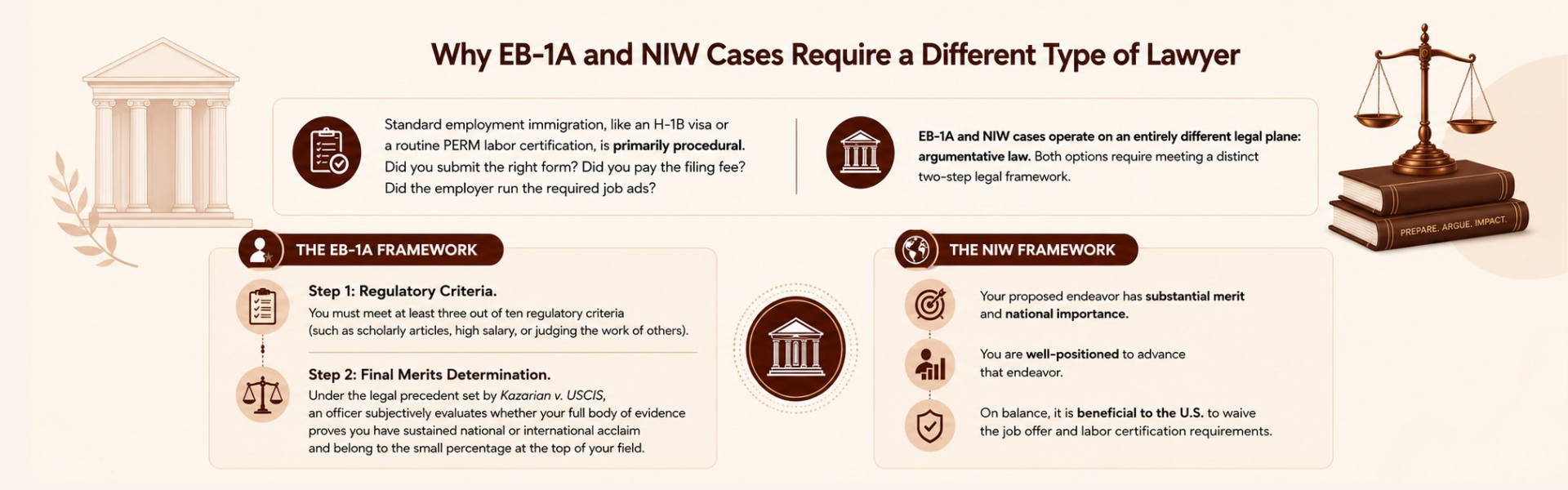
Standard employment immigration, like an H-1B visa or a routine PERM labor certification, is primarily procedural. Did you submit the right form? Did you pay the filing fee? Did the employer run the required job ads?
EB-1A and NIW cases operate on an entirely different legal plane: argumentative law. Both options require meeting a distinct two-step legal framework:
The EB-1A Framework
Step 1: Regulatory Criteria. You must meet at least three out of ten regulatory criteria (such as scholarly articles, high salary, or judging the work of others).
Step 2: Final Merits Determination. Under the legal precedent set by Kazarian v. USCIS, an officer subjectively evaluates whether your full body of evidence proves you have sustained national or international acclaim and belong to the small percentage at the top of your field.
Read More: Beyond the Checklist: Why Meeting EB-1A's Three Criteria Doesn't Guarantee Approval
The NIW Framework
Under the Matter of Dhanasar framework, your attorney must prove three specific prongs:
- Your proposed endeavor has substantial merit and national importance.
- You are well-positioned to advance that endeavor.
- On balance, it is beneficial to the U.S. to waive the job offer and labor certification requirements.
A lawyer who spends 90% of their week doing routine H-1B renewals or family-based petitions often lacks the deep narrative architecture needed to translate your niche contributions (whether in machine learning algorithms, oncology research, or cross-border venture capital) into legal arguments that a USCIS officer can digest.
Key Vetting Criteria: 5 Green Flags vs. 5 Red Flags
When evaluating legal representation, you need to separate substantive expertise from sales pitches. Use this framework during your firm outreach:
| Evaluation Dimension | Green Flag (What to Look For) | Red Flag (What to Avoid) |
|---|---|---|
| Case Evaluation | Offers a realistic assessment of weak spots and a strategy to strengthen them. | Guarantees 100% approval or aggressively pushes "money-back guarantee" marketing. |
| Brief Drafting | Experienced legal staff draft personalized, deep-dive legal briefs from scratch. | Outsources legal drafting to offshore contractors or relies heavily on unedited AI templates. |
| Recommendation Letters | Tailors expert letters to specific legal prongs and your unique contributions. | Gives you standard, generic template letters to "fill in the blanks" yourself. |
| Field Specialization | Demonstrates experience with your specific domain (e.g., AI research vs. founder metrics). | Treats all STEM or business profiles with a single, cookie-cutter filing strategy. |
| RFE/NOID Handling | Transparently outlines RFE/NOID representation within a clear, flat-fee structure. | Hides massive unexpected fees for RFE responses or refuses to represent you if an RFE occurs. |
5 Crucial Questions to Ask During Your Consultation
Most initial consultations feel like a sales pitch. You can flip the script by asking questions that reveal how the firm actually operates behind the scenes.
1. "Who will actually draft my legal petition brief?"
You want to know if the attorney sitting across from you is writing the brief, or if it's being handed off to a junior paralegal or external contractor. While paralegals support the evidence gathering, the strategic narrative should be built by someone who understands federal court precedents and USCIS policy shifts.
2. "How do you handle the 'Final Merits' test for EB-1A, or 'National Importance' for NIW?"
If an attorney responds by simply listing the criteria, saying, "We just need to show you have 100 citations and 3 published papers," that is a red flag. Listen for how they articulate narrative framing. They should talk about context, commercial impact, independent expert testimony, and proving your influence on the broader industry.
3. "What is your approach to drafting expert recommendation letters?"
Recommendation letters are key evidence, but they can easily backfire:
- Generic, Boilerplate Letters: Templates filled with vague praise often trigger immediate Requests for Evidence (RFEs) or Notices of Intent to Deny (NOIDs) from USCIS officers.
- Strategic, Tailored Letters: Custom letters focused on specific impact metrics and tied directly to legal requirements create a bulletproof case.
If an attorney gives you a generic letter template and says, "Have your boss sign this," walk away. The right attorney will interview you, review your work, and draft personalized letters that highlight specific legal prongs.
4. "What happens if we receive an RFE or a NOID?"
USCIS trends shift, and even strong cases can face an unexpected RFE. Ask directly: Is the RFE response covered under the initial flat fee? What is your strategy if we encounter a tough officer? A trustworthy firm stands by its work and has a clear game plan for responding to challenges without surprising you with hidden fees. Review the firm's pricing terms and conditions before you sign.
5. "How do you evaluate candidates with profile metrics similar to mine?"
Avoid asking for overall "approval rates," as those numbers can easily be manipulated by rejecting any case that isn't an absolute slam dunk. Instead, ask how they have handled cases with metrics similar to yours. If you have low citations, a unique startup background, or an unconventional academic path, ask how they built the narrative for candidates in your situation.
Understanding Firm Types: Boutique vs. High-Volume Factories
Not all law firms are structured the same way. The market generally falls across a spectrum of three primary operational models:
| Firm Type & Model | The Pros | The Cons |
|---|---|---|
| 1. Mega-Volume "Case Factories" High volume, low margin. They rely heavily on standard templates and standard intake forms. |
Often cheaper upfront. | You may rarely speak to an attorney. If your profile doesn't fit a standard mold, pushing back against a nuanced RFE can be difficult. |
| 2. Pure DIY Legal Platforms Software-driven self-filing tools with minimal legal review. |
Cost-effective for individuals on a tight budget. | Software cannot construct a creative legal argument. If your case relies on contextualizing niche achievements, DIY tools can leave you vulnerable. |
| 3. Boutique High-Touch Firms Lower volume, custom narrative architecture, and direct partner or senior attorney involvement. |
Tailored legal strategy, nuanced letter drafting, and strong RFE defense. | Higher initial financial investment. |
A Note on "Money-Back Guarantees"
Be cautious of firms pushing money-back refund policies. To protect their margins, these firms often accept only "slam-dunk" profiles or force clients into overly conservative legal strategies. If your profile requires creative framing, a rigid guarantee model might not serve your long-term goals.
Final Thoughts: Treat This as an Investment in Your Narrative
Your EB-1A or NIW petition is more than a package of forms. It is a formal presentation of your professional life's work to the United States government.
When choosing an immigration attorney, look beyond marketing promises and flashy approval statistics. Look for a strategic partner, someone who understands your field, respects your contributions, and possesses the legal skill to translate your achievements into a compelling argument for permanent residence.
Schedule two or three consultations, ask challenging questions, and select the counsel that offers clear strategy over easy promises. You can review our immigration attorneys and the full range of our services before you book.
FAQs
1. Why do EB-1A and EB-2 NIW green card cases require a specialized attorney rather than a general immigration lawyer? +
For an EB-1A, meeting three out of ten initial criteria is only the baseline; the petition must also survive a subjective "Final Merits Determination" proving you belong to the very top of your field. Similarly, an NIW requires proving that your endeavor carries "National Importance" and that waiving the job offer requirement benefits the United States. A generalist lawyer accustomed to routine paperwork often lacks the deep narrative architecture needed to translate complex domain achievements into compelling legal arguments that satisfy USCIS officers.
2. How can I tell if an immigration firm uses a "case factory" or "cookie-cutter" approach? +
If a firm provides generic recommendation letter templates and asks you to fill in the blanks, relies heavily on unedited AI or offshore drafting for legal briefs, or treats every applicant with a single filing strategy regardless of industry context, they are using a cookie-cutter approach. A high-touch, specialized attorney will personally interview you, customize expert recommendation letters to target specific legal prongs, and tailor the narrative around your exact technical or commercial impact.
3. Are "money-back guarantees" or 100% approval claims a good sign when choosing an attorney? +
Because EB-1A and NIW adjudications involve a high degree of subjective officer discretion, no ethical attorney can promise a 100% approval rate. Law firms offering money-back guarantees often maintain conservative screening standards, accepting only "slam-dunk" applicants to protect their profit margins, or they may abandon complex cases when challenged by a tough Request for Evidence (RFE) from USCIS.
4. What questions should I ask during a consultation to properly vet a potential attorney? +
Inquire specifically about their strategy for overcoming the "Final Merits Determination" for EB-1A or the "National Importance" prong for NIW. Finally, ask whether their flat fee covers full representation for potential Requests for Evidence (RFEs) or Notices of Intent to Deny (NOIDs), and ask how they have handled candidates who share profile metrics similar to yours.